SEPTEMBER 2026 - SOMETIMES CONTRACTS FALL APART
By Nate Brill ·
Watch the video version
Nate's quick breakdown of this month's market commentary. Watch on YouTube
We are in a market where home sellers feel like they’re waiting longer for a buyer to come along who loves their home and is ready to write an offer. I’ve written extensively about the psychological toll this can take, and today we’re going to talk about another aspect of the emotional roller coaster of real estate. After waiting to find the right buyer, sometimes, for a multitude of reasons, the contract falls through and the house must go back on the market. Today, we’ll look at what the data tells us about how often this happens before addressing the primary reasons contracts fall through and what you can do to best prepare yourself and your home so that your first contract sticks.
The Numbers Might Surprise You
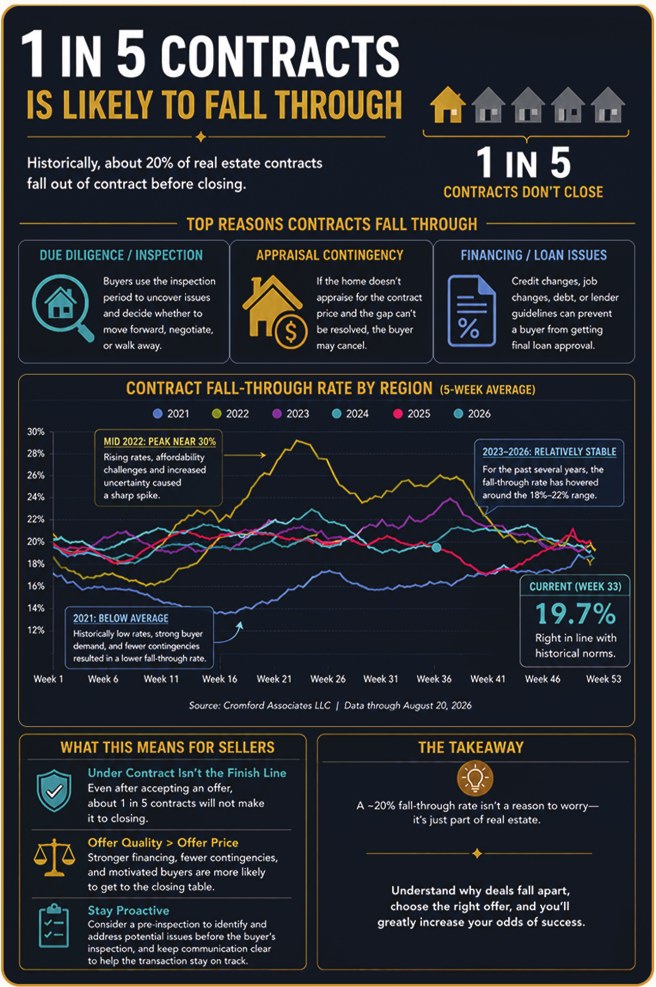
I, like many other professionals I’ve spoken to, assumed the average number of cancelled contracts was around 10%. In reality, it very steadily hovers between 19–21%, or roughly one in five, year after year, with only a few outliers in the last 15 years.
During the buying frenzy of 2021, cancellations fell to a historic low of just over 13%. When interest rates skyrocketed in 2022, the fall-through rate briefly reached nearly 30%. Fortunately, by the end of the year, it settled right back to normal, around 20%.
Why Do Contracts Fall Apart?
Due Diligence/Inspection: This is the most vulnerable time in any transaction. Buyers inspect the home, research the neighborhood, and decide whether to move forward. Inspection findings often lead to negotiations over repairs and concessions, and this is where stubbornness and pride can become the enemies of a productive negotiation. A thorough pre-listing inspection can uncover potential issues beforehand and increase the chances of a successful sale.
Appraisal: With a financed offer, the price must be supported by an independent appraisal. If it comes in below the contract price, the buyer and seller may have to renegotiate, and the buyer may be unable or unwilling to bring additional cash to closing. This is why a properly priced home, supported by recent neighboring sales, is so important. Ultimately, the appraiser’s opinion of value is subjective and, therefore, unpredictable.
Financing: A buyer can look great on paper and still encounter issues obtaining a loan. By this point, many sellers are already packing and may even be days from closing, so a fall-through can be devastating. Strong pre-qualification and a reputable, thorough lender are critical. An offer should never be accepted on price alone. A lower offer from a well-qualified buyer with a strong down payment may be a better choice than a higher offer from a buyer with weaker qualifications.
The Bottom Line
Even good contracts sometimes fall apart. You can’t eliminate the risk, but with preparation, smart pricing, careful evaluation of the buyer, and a willingness to negotiate, you can greatly improve your odds of making it to the finish line.
If you are considering buying or selling a home in the future, or know someone who could use some advice, please give me a call. I’d love to talk nerdy with you! :)
Originally published September 26, 2026 by Nate Brill. Market figures reflect conditions at the time of writing and are not current market data.
Want to talk through what this means for your home?
Nate Brill writes Nerd Talk each month for North Peoria homeowners. Call or text to walk through today's numbers for your street.